
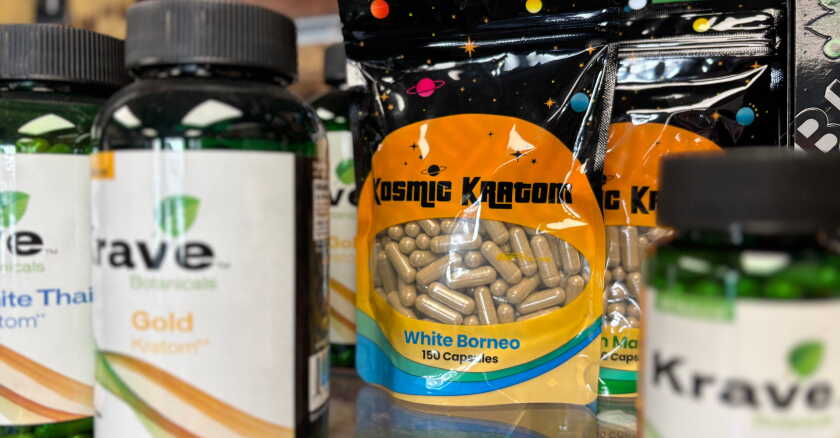
States around the country are wrestling with how to deal with kratom, a drug that Montana Sen. Ellie Boldman dubs “gas station heroin” for its strong effects and the ease with which many people can buy it. Overdoses prompted her to sponsor a ban on kratom, which is currently unregulated in her state, as in several others.
- Kratom is a tree from Southeast Asia whose leaves can be used as a stimulant or sedative, depending on the dosage. Some people use it for pain management.
- As more and more people are found dead with kratom in their systems, some state legislators say a ban is the best way to protect residents.
- The American Kratom Association argues that regulations are enough to keep residents safe, and that natural kratom products are sometimes blamed for harms that could be due to other drugs or to chemically altered kratom products.
“It was actually families themselves that put [kratom] on our radar, and just the unprecedented tragedies, particularly of young men around our state … that were [suffering] fatalities,” Boldman says. About 24 million Americans use kratom, which acts as a stimulant at smaller doses but can have sedating effects in larger amounts. Kratom refers to products derived from the leaves of the kratom tree, native to Southeast Asia. Its first documented use in the U.S. was in 2004, and it gained popularity among people using it to try to quit opioids.
Some people use the drug for energy and focus, as an alternative to caffeine, says Mac Haddow, senior fellow on public policy at the American Kratom Association. Others use it to combat depression and anxiety or, like him, to cope with chronic pain. “I raced motorcycles in college and I banged myself up pretty good,” Haddow says. “I’m paying the price now.” Kratom became more widespread in the U.S. around 2015; that’s the same time that “synthetic” kratom products emerged onto the scene. While natural or botanical kratom includes products like powders made from the dried leaves, “synthetic” products are chemically altered to have higher levels of psychoactive ingredients. A number of synthetic products have vastly elevated levels of the ingredient 7-hydroxymitragynine (7-OH), which some studies find to be 13 times more potent than morphine. Some such products clearly label themselves as synthetic or 7-OH products, but in other cases, consumers may not always realize the kratom they’re buying is a synthetic version or know how much 7-OH is in the product.
From 2015-2025, poison centers in the U.S. saw a 1,200 percent increase in kratom-related calls. Kratom products are often sold online or at convenience stores and gas stations. Kratom powder often costs 50 cents to $2 per recommended dose, while products like gummies or concentrated extracts may cost more. A 2025 study found that, on average, products marketed online as 7-OH cost $3.97 per each recommended dose. State legislators are increasingly worried about overdoses and other dangerous effects.
Between 2019 and 2025, 45 Montanans died of overdoses in which kratom may have contributed, per the state; in three-quarters of those cases, it’s not clear what role kratom played in the death because other drugs were also present in the person’s bloodstream. Other states are charting deaths, too: In Florida over the past decade, nearly 600 people reportedly died from “kratom-related” overdoses, including 46 instances in which kratom was not mixed with another substance.
The federal government cautions against kratom. The Drug Enforcement Administration (DEA) lists it as a “chemical of concern” and says it “can lead to addiction” and sometimes cause hallucinations. The Food and Drug Administration has not approved it for medical use.
States, and even some municipalities, have been taking regulation into their own hands. Thirty-six states introduced kratom-related legislation in the 2025-2026 session. Currently, more regulate kratom than ban it. Twenty-four states have restrictions on sales, like age limits or prohibitions on chemically altered kratom products, and 13 restrict potency.
Meanwhile, 14 states either ban or schedule the drug. Montana is now looking to follow in those states’ footsteps. Boldman’s kratom ban passed in an interim committee and will be taken up during the formal session in 2027.
Synthetic Kratom
The federal government has started turning attention to synthetic kratom compounds. This August, the DEA temporarily listed some of the compounds found in some synthetic kratom products (mitragynine pseudoindoxyl, MGM-15, and MGM-16) as Schedule 1 substances, putting them into the same drug schedule category as LSD and heroin. The DEA has proposed doing the same for products with 7-OH levels above a certain threshold.
Haddow says it’s synthetic kratom products, not natural kratom, that are the real problem. Discussion around the topic too often fails to distinguish between the two, he says.
Haddow argues that there is not enough evidence to justify bans of natural kratom products, but lawmakers should crack down on synthetic versions: “Every elected official should protect their consumers without depriving them of access to a safe product that is well regulated that people can use responsibly.”
But Boldman isn’t buying it. She sees natural kratom products the same as any other drug regulated or banned by governments. “I see it the same way I see heroin, and we don’t make those distinctions there,” she says.
Regulate or Ban?
Per Haddow, 22 states have passed a set of regulations known as the kratom consumer protection act, a policy the American Kratom Association supports. The details of such regulations can vary by state, but involve measures like age-restricting sales, requiring products to list the amount of psychoactive ingredients they contain and limiting 7-OH concentrations. Rather than bans, Haddow says, many states need stronger enforcement of these regulations — potentially funded by excise taxes — to help crack down on the quick spread of synthetic products.
Some Oklahoma officials, however, think the state’s version of the legislation isn’t enough to tackle the problem.
“Synthetically enhanced kratom products are contributing to an alarming rise in overdoses and deaths in our state,” Bureau of Narcotics Director Donnie Anderson said, according to a press release from the Oklahoma state House. “But, because these products are not listed as Controlled Dangerous Substances in Oklahoma, we currently do not have jurisdiction to investigate and shut down the suppliers.”
Oklahoma Rep. Tim Turner, a former narcotics officer, recently announced plans to introduce a kratom ban in 2027, saying, “It is time to stop treating this like just another product on a convenience store shelf.”
Boldman, for her part, says she’d have no issue with kratom being regulated as a pharmaceutical and available only for medical use, if there was demand. But so far, “in Montana and elsewhere, our medical community is the one who absolutely wants it outlawed.”

